2009년 8월 13일 목요일

As I am Korean...


As I am Korean...


I've read part of South Korean law saying "All People have dignity and worth as humanbeing and right to persue their own hapiness. The nation affirms the basic inviolable right which people have, and has duty to ensure it." That shows so-called 'the right to persue one's happiness' of Korean people.

Why was I born? What for am I living? What should I do for the best life people have never had? Perhaps, am I being to be used for some purpose? If so, what is the purpose?

Those are what I've been asking myself continually. Those are probably the reason of existence or the questions for purpose of life.
Anyone, however, never gives the right answer as much as I am satisfied.

2009년 1월 29일 목요일

[int] Asking Directions

Ciara : 실례합니다. 저는 가장 가까운 경찰서를 찾고 있어요.
Ryu : 오른쪽으로 가셔서 두블럭 더 가세요. 그리고.. 그리고..
Ciara : 그 다음에는요?
Ryu : 몰라요.

Ciara : Excuse me. I'm looking for the nearest police station.
Ryu : Make right and go more two blocks... and...and..
Ciara : and then?
Ryu : I don't know.


----------------------------------------------------------------

<2>
Ciara : 저기요. 경찰서가 어디있는지 아세요?
Kim : 오. 왼쪽으로 가시고 곧바로 가세요. 그러면 보일거에요.
Ciara : 정말 고맙습니다.

Ciara : Hey. Do you know where the police station is?
Kim : Oh. Turn left and go straight. Then, you will see.
Ciara : Thanks a lot.


--------------------------------------------------------------

1. excuse me : 실례합니다.
When you need a help from someone, you can say "실례합니다." It's extremly formal.
And "여기요" and "저기요" are also being used in spoken.
Basically, 여기요 is like "here is." and 저기요 is "there is."

2. I don't know : [저는] 몰라요. (opp. 알아요 = I know)
In Korean speaking, Korean people usually omit subjective when a speakers talk about himself or herself and listeners know the answer is on the speaker.

3. Direction : 방향
좌측 or 왼쪽 : left side
우측 or 오른쪽 : right side
straight : 곧바로
back side : 뒤쪽
front side : 앞쪽
to the back side : 뒤쪽에 ( the preposition 'to' used for direction is "~에.")
그러면 : then

4. more : 더 (opp. less : 덜, 조금)
ex> eat more! (더 먹어) - eat less! (조금 먹어!)


#. This is for people who can read Korean without the English instructions.

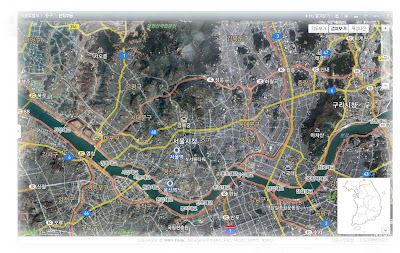
Seoul has 25 administrative divisions

#. The Picture was captured from www.NAVER.com

What's the capital city of South Korea?


The probability what you get the right answer to the question is only less than 15%.


Guess it! Busan? Daegu? Seoul? Gwangju? Ulsan? Daejeon? Incheon?


What you folks are reading here means that you are interested in Korea. Of course, you already know what the capital city of South Korea is.


With the Korean economy growing up, Seoul, the capital city of seoul, has been up to one of the biggiest cities across the world. Even amazing Korean economic growth has been accepted by some developing coutries as a their own economic growth model. (I cannot deny the Korean ecconomy is affected from the U.S.)


How big is Seoul City? As you visit first itme, you probably have a question how the city is distinguished the boundary. The answer is simple. Seoul city is surrounded by a range of mountains and divided into north and south with the Han river(한강[hangang]).


You can check and feel that with the Seoul map on like the Google Earth.


Seoul is only roghly 50km south from the North Korea. (Isn't it a quite short distance?)


The metropolis has lots of satellite cities as like as other cities. The gross Seoul population including the cities around Seoul is about 25 million inhabitants so that Seoul is being assumpted the second largest metropolitan area in the world.


As many as citizens live in Seoul, the city has 25 administrative divisions. (We call an administrative division "gu"[구].) And all the divisions are divided into 522 small towns named "dong"(동)


I will put 25 divisions (gu) on here. But not put 522 towns(dong). (I don't exactly know because there are too many.) ;-p


1. Dobong-gu (도봉구)

2. Dongdaemu-gu (동대문구)

3. Dongjak-gu (동작구)

4. Eunpyeong-gu(은평구)

5. Gangbuk-gu (강북구)

6. Gangdong-gu (강동구)

7. Gangseo-gu (강서구)

8. Gangnam-gu (강남구)

9. Geumcheon-gu (금천구)

10. Gangseo-gu (강서구)

11. Guro-gu (구로구)

12. Gwanak-gu (관악구)

13. Gwangjin-gu (광진구)

14. Jongno-gu (종로구)

15. Jung-gu (중구)

16. Jungnan-gu (중랑구)

17. Mapo-gu (마포구)

18. Nowon-gu (노원구)

19. Seocho-gu (서초구)

20. Seodaemun-gu (서대문구)

21. Seongdong-gu (성동구)

22. Songpa-gu (송파구)

23. Yangcheon-gu (양천구)

24. Yeongdeungpo-gu (영등포구)

25. Yongsan-gu (용산구)

--NEW WORDS------------------------------------------
강 [gang] : river
한강 [hangang] : the Han River which is across the city of Seoul
남 [nam] : south
북 [buk] : north
서 [seo] : west
동 [dong] : east
강남 [gangnam] : South from the Han River
강북 [gangdong] : North from the river
강서 [gangseo] : West from ~
강동 [gangdong] : East ~

서울[Seoul, sa;ul] : Seoul
~구 [-gu] : a administrative division such as 동대문구, 도봉구, and so on.


2009년 1월 27일 화요일

Get the tailored Korean class for you!

Get the tailored Korean class for you!

- With understdanding Korean things including politics, economy, society, culture, and so on, get Korean languages.

- Basically, the Korean class could be different offline and online.
- Experieced of teaching Korean with English speaking to American, Philiphinos, Sri Lankan, Japanese and lots of Chinese in NY and Seoul. - You can choose teaching language among Korean, English and Chinese.

#. Class Classification

- Practical Intensive Course (Only Offline Available)

- Preparation for the Korean test (Only Offline Available)

- Freetalking

- Learning Koean with k-pops.

- Korean News for you- Disscussion

# You must...

1. take your mind to study and learn Korean crazily.

2. not understand and think on the side of your culture.

3. have positive and critical thinking.


# Ways to learn (you can choose before you learn)

1. Offline (You should be in Seoul or around Seoul.)

- in-person learning

- phone

2. Online

- e-mail (for your writing)

- voice chatting (for your speaking and listening)

- international phone call *- video chatting *

Korean Religion


Korea has mainly three kinds of religion, Confucianism, Buddism and Christianity.


Starting the middle of the 20th century, Christianity could prosper and has competed with Buddhism. Christianity were affected by Korean Shamanism, Taoism and Buddhism.


With many people insist that Buddists are half of Koreans or Christians are half of Koreans, in 2005, the Korean government announced the statistics of the rate. roughly 46% of the Koreans don't have a particular religion. It means that they could be in Korean Shamanism and Confucianism. Christians are 29.2% of the population of which are Catholics 10.9% and Protestants 18.3%.


Islam is also in Korea. Not many people belive, but it's growing up with about 100,000 foreign workers and immigrants from Muslim countries.

2009년 1월 26일 월요일

Korean New Year (2)


Korean New Year (2) - The memorial service for Korean's own ancestors.


I am not sure whether "the memorical service for ancestors" is translated in english correctly. Anyway, as you can see the picture, it's called "cha rae"[차례]. It's kind of the respectful service for Koreans' own ancestors.
It's originated from Confucianism which was accepted in the Chosun dynasty as a national religion and a efficiently ruling idea.
I think you already know that Koreans love hot and spicy food. But you won't find out hot and spicy food on the service. It's totally banned that hot, spicy and red color food including peppers and garlics is put on because the red means that ancestors' spirits don't prefer. Obviously, it could be kind of shamanism or idolraty, which is believing idols.
Because Koreans practice worships for acestors like idols, Christian people deny this ritual ceremony with one of the Ten Commandments from the Holy Bible that says "I am the LORD thy God, thou shalt have no other gods before me."
There are other regulations when Koreans set up the table. Fish should be on east and fish's head should be headed for right side. Meat should be on west-side. Koreans put dried seafood like a squid on the left side of the table. And red-colored fruits like apples are on right side of the table.
As like that there are lots of dialects from each area in one language, the methods how to set up are different from family, region, and so on.
차례(charae), the memorial service for ancestors, is usually being held twice a year, 설날(the Korean new year) and 추석(chusok : the Korean Thanksgiving day).
----NEW WORDS
차례 (charae) : the ancestral memorial service in Korea
a picture : 사진[sa jin]
Confucianism : 유교 (you gyo)
Christianism : 기독교 (gi dok gyo)
Buddhism : 불교 (bul gyo)
#. ~교 means a kind of religion.
an apple : 사과(sa gwa / sa gua)
a squid : 오징어 (oh jing oe)
----QUIZ
WHAT is "the memorial service for ancestors" called in Korean?

Korean New Year


Korean New Year
Koreans usually celebrate New Year twice. One is from the solar calender, the other one is for the lunar new year. In the past thime before I or my parents came up on the world, Asian people had a tendency to follow the lunar calender. I think the Pacific Asian people had regarded the lunar was a kind of pivotal standard for the life.
Firstly, I don't want to mention and explain about the lunar calender because I think you are here with your interests of Korean things or Asian things. Unless you were, you can type in "the lunar calender" and get some information or contents about it.
I remember that some of media say Asian people have Chinese New Year. When I read, I got depressed. Why was it from China? I don't know and can not find out where the origin from. It's obvious that there are lots of hypothesis and assumptions but I can not insist which one is logical and valid. Anyhow, I want the New Year on the lunar callender to be called like "the Lunar New Year" now that China, Japan, Mongol, Vietnam or others which I don't know have a celebration of the lunar new year.
The Korean New Year is known as "Seollal" [설날] . It has other names such as "Sesu", "Wondan", "Sinwon" or "Wonil." It's the biggest Korean festival with "Chusok"[추석].
(Chusok is like the Korean Thanksgiving day.)
Starting the Japanese period, the Korean has accepted the solar calender.
Koreans have solar and lunar new year celebrations now. The solar new year is called "sin jeong"[신정], the other one is "goo jeong."[구정] . Part of Korean conservertives asks Koreans not to use "sin jeong" and "goo jeong" because the two words were from Japanese expressions.
What does the Korean do on Seollal? As is the case with other countries, Koreans also have like New Year's resolutions and greeting with their precious reletives. With roughly a couple of weeks to go before Seollal, Koreans send some postal mails with their sweat hearts.
Many people go back to their hometown where they had been grown up. Many Korean people with dreams of success gathered into Seoul or around Seoul from other cities or provinces in 1970's. Those were the babyboom genereation from their parents suffered from the Korean War. By virtue of their efforts, South Korea could stand and come up.
On one or two days before Sollal, lots of cars are clogging up on all the highways and all tickets for travellers on the holidays are sold out. Do you want to feel the day? Just take your car on highways. You may have to wash your hands around highways, not in a restroom of service area.
With pleasure of getting together with family, they are going back their hometown on that day even if they get great tons of stress.
On Seollal, Koreans have new year's greeting, called "Sebae"[세배]. Young people bow formaly in Korean ways, with kneeling down and bending their body, to their parents or grand parents. (You can see the pictures on the top of the post.)
--NEW WORDS-----------------------
세배 (sebae) - bow formaly in Korean ways.
설날 (sollal) - the Korean New Year based on the solar or lunar callender
신정 (sinjeong) - the Korean solar new year. The word might be from Japan.
구정 (goojeong) - the Korean lunar new year.
고향 (gohyang) - the hometown where you were born and grown.
추석(chusok) - the Korean Thanksgiving day. It's not the same with the American or Canadian one.
할아버지(hal ah bu ji) - grandfa
할머니 (halmoni) - grandma
아버지 (abeoji) - father [formal]
아빠 (abba) - dad [informal]
어머니 (oemoni) - mother [formal]
엄마 (eomma) - mom [informal]
중국(joongguk) - China
몽골(mongol) - Mongol
일본(ilbol) - Japan
아시아(Ah si ah) - Asia
-------------------------------
Quiz.
What's the Korean lunar new year called in Korean?
Why the Korean gets the traffic congestion on highways during the national holidays?